
An Introduction to the Marking of Carts
Here you will find the answers to some of the most frequently asked questions concerning the Marking of Carts and to serve as a guide for those entering or considering entering Carts into this important City event.
History
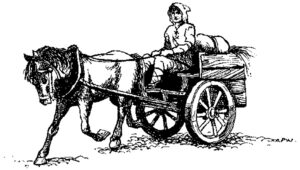 Much of the history of Cart Marking is recorded elsewhere, but certain factors are pertinent to the maintenance of the tradition today. A Carman Fellowship has existed since before 1277. This became the Fraternyte of Seynt Katryne the Virgin and Master of Carters in 1517 which then agreed to serve the City in various ways and to carry goods at reasonable rates. After falling out with the City, control of Carts passed to Christ’s Hospital, back to the City and then back to Christ’s again in 1665.
At this time the decision was made that each Cart licensed to ply for hire in the City of London should be marked on the shafts with a City Coat of Arms and a number on a brass plate.
By 1835 there were 600 licensed Carts but in 1838 all previous legislation was repealed. The licensing of carts was then vested in the City under the control of the General Purposes Committee, with operations being vested in the Keeper of the Guildhall and records being maintained by the City Remembrancer. The annual fee was set at five shillings, and the penalty for operating without a licence, twelve shillings and six pence. It is important to remember that this legislation remains in force today, and ONLY the Corporation of the City of London (the City Civic) has the right to Mark Carts.
The conditions attached to Cart licensing require the ‘Cart Man’ be member of the Fellowship of Carmen and to have an authorised Carroom or stand (similar to a taxi rank) from which to ply for hire. By the turn of that century only 16 Carmen held licences, albeit between them they had 111 licences and 89 carrooms. By 1965 the remaining 16 carrooms were abolished as they were not utilised, although arrangements were made for one carroom to be available on one day per year in order that tradition could be maintained. This is used by new Master each year for Cart Hiring immediately following Installation. Interestingly, it is generally accepted that Cart Marking represents the first ever form of vehicle licensing.
Cart Marking Resumption
In 1982 five Liverymen decided to present Carts for marking in accordance with the legislation of 1838 and arranged with willing officials at Guildhall to attend together on a pre-arranged day in July. Guildhall kindly produced a brazier and branding iron and advised that the last previously used number was No. 230. Consequently the ‘Carts’ duly arrived bearing the numbers 231 to 235. After Marking had taken place a small party retired to a local hostelry for refreshment where it was decided to repeat the exercise the following year. In 1983 there were more Carts as others joined in.
Each year the event has grown in size and 2017 saw the largest number of entries in the Carmen’s 500th year. This is mainly owing to the support it receives from our livery and increasing awareness by the public. Less than a decade after its new beginning, attendances warranted a luncheon in Guildhall after Cart Marking, originally held in the Crypt but now a sell-out with over 600 guests seated in the Great Hall. The luncheon is a Carman event while Cart Marking itself remains the responsibility of the City Civic.
Cart Marking Today
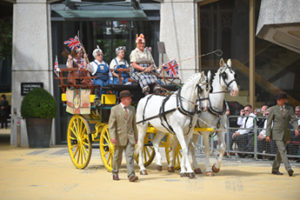 The growth of the event, coupled with numerous legislative requirements, not least those related to Health and Safety, Highways and the Police, means that planning for each year’s event begins immediately after the previous one has finished. Although responsibility rests with Guildhall, the actual organisation is entrusted to our Livery and is exercised through a panel whose members embrace all interested parties, although not all are required to attend every meeting. The panel comprises a Chairman and Vice-Chairman (jointly responsible for Cart selection), several members with professional knowledge of ‘Carts’ – ancient, modern, specialized and horse-drawn – a lead commentator, an advertising sales person and a programme designer.
Other panel representatives are drawn from the police, City Highways (who advise on road works, meter closures and even the re-timing of traffic lights), and of course Guildhall who are responsible for seating, public address, yard security and more. The Carmen’s Clerk and Deputy Clerk are also involved in the planning as well as organising the luncheon.